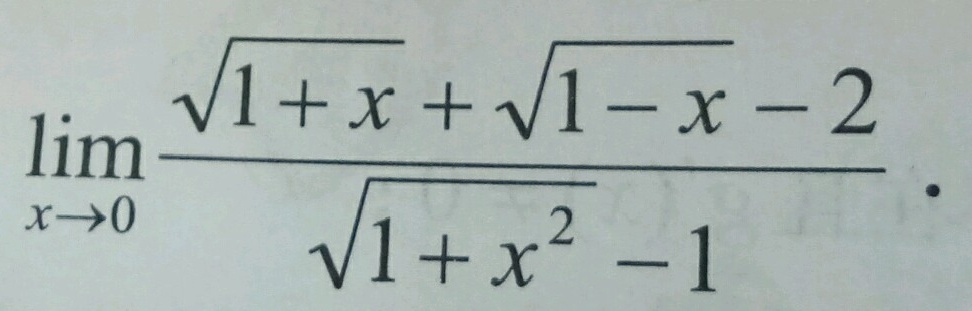
lim _(xarrow 0)dfrac (sqrt {1+x)+sqrt (1-x)-2}(sqrt {1+{x)^2}-1}

题目解答
答案
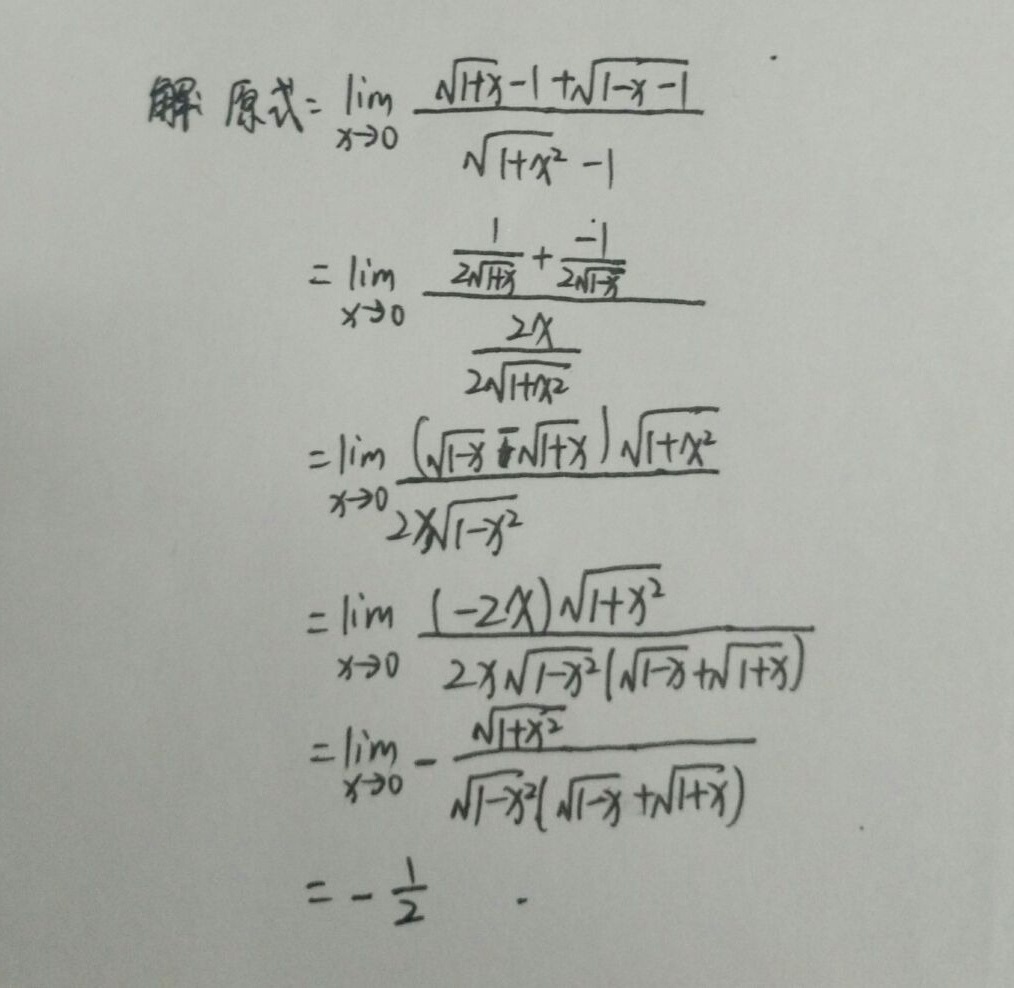
解析
本题主要考察极限的计算,涉及无理式的极限求解,关键思路是通过分子分母有理化消去极限中的零因子($x \to 0$时的$0$项),再利用等价无穷小替换或直接代入计算。
步骤1:识别零因子,分子分母分别有理化
当$x \to 0$)时,分子$\sqrt{1+x}+\sqrt{1-x}-2 \to 0$,分母$\sqrt{1+x^2}-1 \to 0$,属于$\frac{0}{0}$型极限,需先消去零因子。
分母有理化
分母$\sqrt{1+x^2}-1$乘以共轭根式$\(\sqrt{1+x^2}+1$):
$\sqrt{1+x^2}-1 = \frac{(\sqrt{1+x^2 -1)(\sqrt{1+x^2}+1)}{\sqrt{1+x^2}+1} = \frac{(1+x^2)-1}{\sqrt{1+x^2}+1} = \frac{x^2}{\sqrt{1+x^2}+1}
\quad(1)$
分子有理化
分子$\sqrt{1+x}+\sqrt{1-x}-2$分组处理:
$\sqrt{1+x}-1 + \sqrt{1-x}-1$
对每组分别乘以共轭根式:
- $\sqrt{1+x}-1 = \frac{(\sqrt{1+x}-1)(\sqrt{1+x}+1)}{\sqrt{1+x}+1} = \frac{x}{\sqrt{1+x}+1}$
- $\sqrt{1-x}-1 = \frac{(\sqrt{1-x}-1)(\sqrt{1-x}+1)\}/(\sqrt{1-x}+1) = \frac{-x}{\sqrt{1-x}+1}$
分子相加:
$\sqrt{1+x}+\sqrt{1-x}-2 = x\left( \frac{1}{\sqrt{1+x}+1} - \frac{1}{\sqrt{1-x}+1}\right)$
通分:
$x\left[ \frac{(\sqrt{1-x}+1) - (\sqrt{1+x}+1)}{(\sqrt{1+x}+1)(\sqrt{1-x}+1)} \right] = x\left[ \frac{\sqrt{1-x}-\sqrt{1+x}}{(\sqrt{1+x}+1)(\sqrt{1-x}+1)} \right]$
对$\sqrt{1-x}-\sqrt{1+x$再次有理化:
$\sqrt{1-x}-\sqrt{1+x} = \frac{(\sqrt{1-x}-\sqrt{1+x}})(\sqrt{1-x}+\sqrt{1+x})}{(\sqrt{1-x}+\sqrt{1+x})} = \frac{(1-x)-(1+x)}{\sqrt{1-x}+\sqrt{1+x}} = \frac{-2x}{\sqrt{1-x}+\sqrt{1+x}}$
代入分子:
$\sqrt{1+x}+\sqrt{1-x}-2 = x\left[ \frac{-2x\}/(\sqrt{1-x}+\sqrt{1+x}) \right] / [(\sqrt{1+x}+1)(\sqrt{1-x+1)] = \frac{-2x^2}{(\sqrt{1+x}+1)(\sqrt{1-x}+1)(\1-x+\sqrt{1+x})}\quad(2)$
步骤2:代入原式化简
将式(1)、式(2)代入原式:
$\text{原式} = \lim_{x \to 0} \frac{\frac{-2x^2}{(\sqrt{1+x}+1)(\sqrt{1-x}+1)(\sqrt{1-x}+\sqrt{1+x})}}{\frac{x^2}{\sqrt{1+x^2}+1}}$
约去$x^2$:
$\text{原式} = \lim_{x \to 0} \frac{-2}{(\sqrt{1+x}+1)(\sqrt{1-x}+1)(\sqrt{1-x}+\sqrt{1+x})} \cdot (\sqrt{1+x^2}+1)$
步骤3:代入$x=0$计算极限
当$x \to 0$时,$\sqrt{1+x} \to 1}$,$\sqrt{1-x} \to 1$,$\sqrt{1+x^2} \to 1$,代入得:
$\text{原式} = \frac{-2}{(1+1)(1+1)(1+1)} \cdot (1+1) = \frac{-2}{2 \times 2 \times 2} \times 2 = -\frac{2}{4} = -\frac{1}{2}$