题目
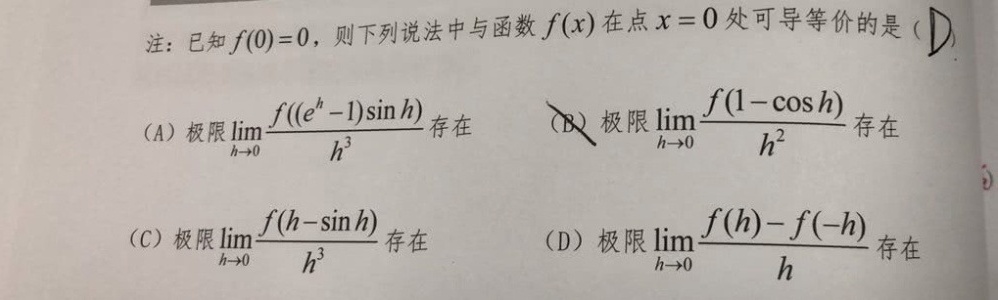
注:已知 (0)=0, 则下列说法中与函数f(x)在点 x=0 处可导等价的是 ()-|||-(A)极限 lim _(harrow 0)dfrac (f(({e)^h-1)sin h)}({h)^3} 存在-|||-(B)极限 lim _(harrow 0)dfrac (f(1-cos h))({h)^2} 存在-|||-(C)极限 lim _(harrow 0)dfrac (f(h-sin h))({h)^3} 存在-|||-(D)极限 lim _(harrow 0)dfrac (f(h)-f(-h))(h) 存在
题目解答
答案
D. 极限 $\lim _{h\rightarrow 0}\dfrac {f(h)-f(-h)}{h}$ 存在
解析
步骤 1:分析函数在点 x=0 处可导的定义
函数f(x)在点 x=0 处可导,意味着存在极限 $\lim _{h\rightarrow 0}\dfrac {f(h)-f(0)}{h}$,即 $\lim _{h\rightarrow 0}\dfrac {f(h)}{h}$ 存在。因为已知 f(0)=0。
步骤 2:分析选项 (A)
考虑极限 $\lim _{h\rightarrow 0}\dfrac {f(({e}^{h}-1)\sin h)}{{h}^{3}}$。由于 $\lim _{h\rightarrow 0}({e}^{h}-1)\sin h = 0$,所以这个极限的存在性与f(x)在x=0处的导数没有直接关系,因为分子中的函数值趋向于0的速度可能与分母不同,不能直接判断f(x)在x=0处的导数是否存在。
步骤 3:分析选项 (B)
考虑极限 $\lim _{h\rightarrow 0}\dfrac {f(1-\cos h)}{{h}^{2}}$。由于 $\lim _{h\rightarrow 0}(1-\cos h) = 0$,且 $1-\cos h$ 的阶数为 $h^2$,所以这个极限的存在性与f(x)在x=0处的导数没有直接关系,因为分子中的函数值趋向于0的速度可能与分母不同,不能直接判断f(x)在x=0处的导数是否存在。
步骤 4:分析选项 (C)
考虑极限 $\lim _{h\rightarrow 0}\dfrac {f(h-\sin h)}{{h}^{3}}$。由于 $\lim _{h\rightarrow 0}(h-\sin h) = 0$,且 $h-\sin h$ 的阶数为 $h^3$,所以这个极限的存在性与f(x)在x=0处的导数没有直接关系,因为分子中的函数值趋向于0的速度可能与分母不同,不能直接判断f(x)在x=0处的导数是否存在。
步骤 5:分析选项 (D)
考虑极限 $\lim _{h\rightarrow 0}\dfrac {f(h)-f(-h)}{h}$。由于f(0)=0,所以这个极限可以写成 $\lim _{h\rightarrow 0}\dfrac {f(h)-f(0)}{h} + \lim _{h\rightarrow 0}\dfrac {f(0)-f(-h)}{h}$,即 $\lim _{h\rightarrow 0}\dfrac {f(h)}{h} + \lim _{h\rightarrow 0}\dfrac {f(-h)}{-h}$。如果这个极限存在,那么f(x)在x=0处的导数存在,因为这相当于从正负两个方向求导数,且这两个方向的导数相等。
函数f(x)在点 x=0 处可导,意味着存在极限 $\lim _{h\rightarrow 0}\dfrac {f(h)-f(0)}{h}$,即 $\lim _{h\rightarrow 0}\dfrac {f(h)}{h}$ 存在。因为已知 f(0)=0。
步骤 2:分析选项 (A)
考虑极限 $\lim _{h\rightarrow 0}\dfrac {f(({e}^{h}-1)\sin h)}{{h}^{3}}$。由于 $\lim _{h\rightarrow 0}({e}^{h}-1)\sin h = 0$,所以这个极限的存在性与f(x)在x=0处的导数没有直接关系,因为分子中的函数值趋向于0的速度可能与分母不同,不能直接判断f(x)在x=0处的导数是否存在。
步骤 3:分析选项 (B)
考虑极限 $\lim _{h\rightarrow 0}\dfrac {f(1-\cos h)}{{h}^{2}}$。由于 $\lim _{h\rightarrow 0}(1-\cos h) = 0$,且 $1-\cos h$ 的阶数为 $h^2$,所以这个极限的存在性与f(x)在x=0处的导数没有直接关系,因为分子中的函数值趋向于0的速度可能与分母不同,不能直接判断f(x)在x=0处的导数是否存在。
步骤 4:分析选项 (C)
考虑极限 $\lim _{h\rightarrow 0}\dfrac {f(h-\sin h)}{{h}^{3}}$。由于 $\lim _{h\rightarrow 0}(h-\sin h) = 0$,且 $h-\sin h$ 的阶数为 $h^3$,所以这个极限的存在性与f(x)在x=0处的导数没有直接关系,因为分子中的函数值趋向于0的速度可能与分母不同,不能直接判断f(x)在x=0处的导数是否存在。
步骤 5:分析选项 (D)
考虑极限 $\lim _{h\rightarrow 0}\dfrac {f(h)-f(-h)}{h}$。由于f(0)=0,所以这个极限可以写成 $\lim _{h\rightarrow 0}\dfrac {f(h)-f(0)}{h} + \lim _{h\rightarrow 0}\dfrac {f(0)-f(-h)}{h}$,即 $\lim _{h\rightarrow 0}\dfrac {f(h)}{h} + \lim _{h\rightarrow 0}\dfrac {f(-h)}{-h}$。如果这个极限存在,那么f(x)在x=0处的导数存在,因为这相当于从正负两个方向求导数,且这两个方向的导数相等。